
Beware the Mirror
Black Minstrelsy and Horror
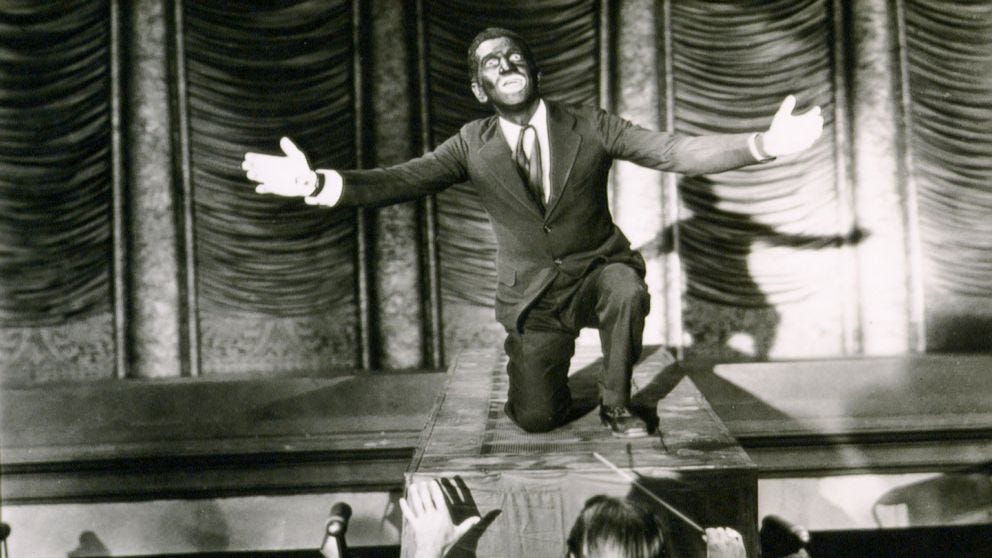
A figure steps into the glow of stage light, his face darkened into a flat, artificial shade that absorbs detail and sharpens contrast. Greasepaint stretches across his skin and catches the light in dull patches. His lips are outlined, his eyes widened, his movements loosened into a performance elastic and deliberate. He sways, then snaps into motion, each gesture slightly too large, each expression held a fraction too long. The air fills with sound. Laughter rises quickly, almost on cue, followed by murmurs that ripple through the room. The performance does not need explanation.
As the performance continues, the face begins to hold in the wrong way. The grin stays where it is after the rest of the expression should have moved on, and the paint around the mouth starts to tighten, as if it has dried into the shape it was meant to keep. The eyes remain open with an effort that slowly becomes visible; the lids look strained, reluctant to blink, the skin around them pulled taut beneath the stage light. Even the movement begins to change. The arms rise and fall with such exact recurrence that the joints seem to lose their ease, each motion returning to the same angle as though the body has been set there and corrected whenever it drifts. The heat of the sage lights brings a faint sheen through the greasepaint, but instead of softening the face it seems to seal it over, leaving the features fixed beneath a surface that will not relax. The room keeps laughing while the paint tightens across the mouth and dries the grin where it sits. The skin at the eyes shines with strain, the cheeks hold too still, and each returning gesture seems to fasten the body more firmly into the same expression. The grease paint cures like a second skin.
Mary Louise Pratt’s concept of the contact zone provides a precise way to understand this process. The contact zone names a space where representation is produced under asymmetrical power, where one group determines how another is made visible. In this space, expression lacks freedom and instead takes shape through negotiation and constraint. Blackness depicted in American visual culture emerges within this structure.
Minstrelsy operates as one of the earliest and most explicit forms of this contact zone. Black identity becomes translated into a system of signs designed for recognition by a dominant audience. Exaggeration compresses complexity into something immediate. Repetition stabilizes that compression until it feels natural. Over time, the performance loses any sense of construction and begins to register as obvious. What is being seen feels familiar because it has been produced to feel that way.
Cinema intensifies this system. The camera fixes what was once fluid. It preserves gesture and circulates distortion without alteration. In doing so, it removes the variation that live performance once allowed. What was once an act becomes a template. Each new image confirms what has already been established. At this point, the contact zone can be located in concrete practices. casting, scripting, censorship boards set the limits of what can appear on screen. Exhibition spaces and marketing frame how those images are introduced and received. Spectatorship is trained through repetition, so recognition precedes interpretation. Within this arrangement, Black figures arrive with meanings already attached. Gesture and framing cue the viewer toward a narrow set of readings, while alternative meanings are screened out. The result is a controlled field of visibility in which interpretation is guided in advance rather than discovered in the moment.
Horror inherits this structure in a concentrated form. The genre depends on the body as a site of visibility. Under these conditions, pre-existing visual codes intensify. The Black body enters horror already structured by repetition and positioned within a system that emphasizes visibility while limiting interior depth. Fear exposes this condition rather than producing it. Across film history, this pattern persists and shifts form. Minstrelsy establishes the logic of legibility. Early cinema stabilizes that logic within visual form. Horror amplifies its effects through exposure. Contemporary films begin to expose the structure itself, drawing attention to the conditions that produce these images. The contact zone makes this continuity visible. It shows that representation operates as an ongoing process shaped by power and repetition.
What appears on screen emerges from a system that determines how Blackness can be seen before it is ever understood. Within this constraint, autoethnography offers a counter-practice: a way of working inside dominant forms while bending them toward self-representation. By appropriating familiar genres, visual codes, and narrative frames, Black creators can redirect recognition without abandoning legibility, inserting lived experience into structures that would otherwise exclude it.
Mirror Pond
The pond waits, emptied of memory,
its surface an eye that does not close.
It draws the world inward,
trees leaning, sky sutured to water,
a quiet taking, a patient undoing.
An echo blooms like a reed
slender, reaching, craving the sun.
The wind pushes, and I call it movement,
the ripples spreading like a song unsung.
The pond cares not for voice
Its language is a held breath,
a pull that does not announce itself,
only repeats what it can contain.
Deeper, the water begins to shift.
The clarity gives way at the edges
as if sight itself were tiring.
What I see wavers:
a figure, stretched thin as a thread,
its shadow a weight the water swallows.
I stayed too long.
The pond tilts against me
a refusal, or perhaps a warning.
The pond leans toward me,
a slight correction.
The reflection thins, comes apart,
leaving the surface unmarked,
complete without me.
By the time I rise,
the pond has settled.
Behind me, reeds rasp together
their roots sunk deep in the mud where light ends
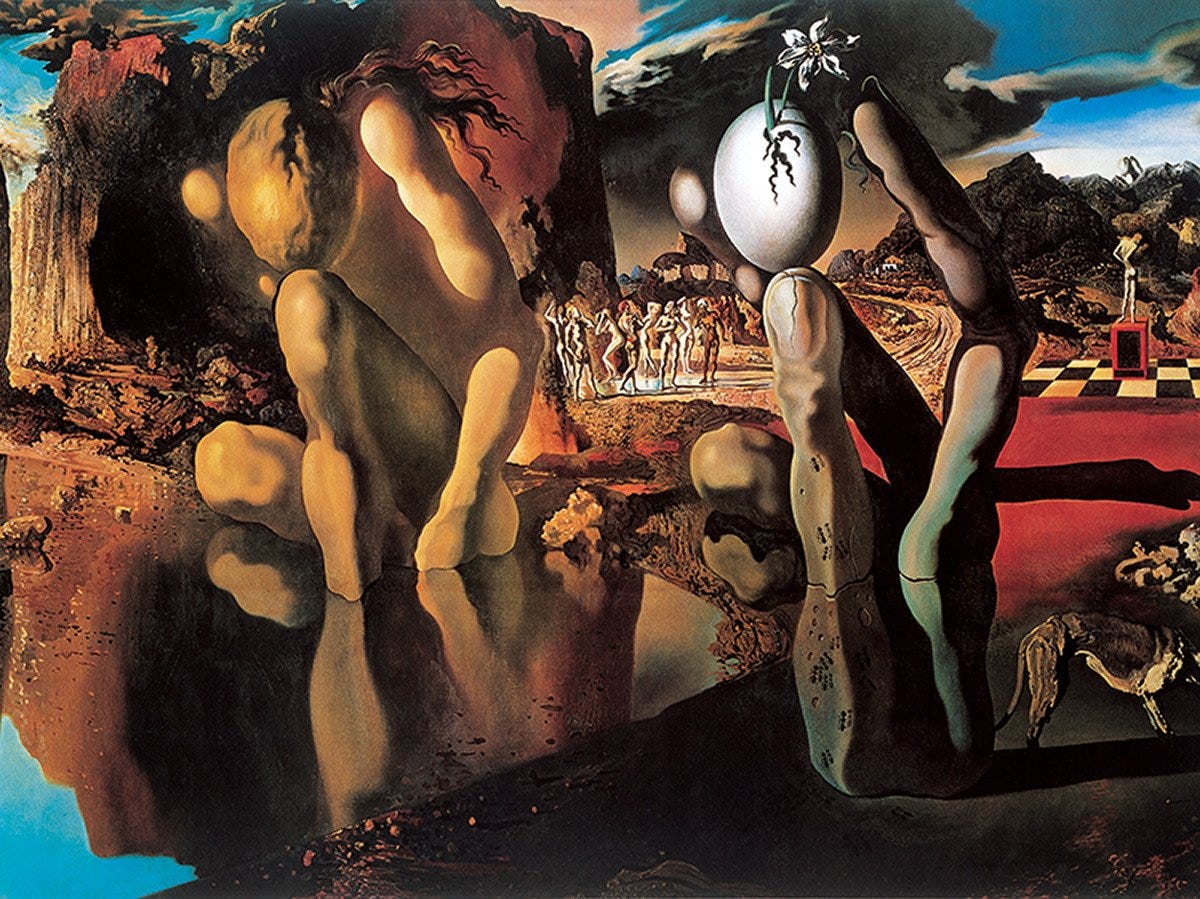
Black minstrelsy shapes how American cinema learns to see. It operates like a mirror calibrated for an audience, returning a controlled image of Blackness that appears familiar the moment it is seen. It produces an image designed for immediate recognition, prepared in advance for those watching. What appears on stage functions as this mirror, sending back a version of Blackness that aligns with tradition. Gestures recur with slight variation until they form a pattern.
Audiences grew attached to this imagery. The reflected version becomes preferable to anything more complex or unfamiliar. That attachment carries consequences. It narrows perception within the dominant culture, training viewers to accept a reduced image as sufficient. It also fixes Black subjects within a frame that limits how they can appear, constraining expression to what the mirror can return. Before film captured movement, Blackness had been reduced into a visual code that prioritized recognition. Nineteenth-century blackface performance created images that could be read instantly. Gesture carried meaning. Over time, viewers learned to recognize these images without question. There is a persistent yearning within the dominant culture to project itself into the image, to see its own desires confirmed in the mirror, a pull so strong it risks submerging both the viewer and the figure it fixes.
Film gives minstrel logic durability. What once depended on live performance, becomes fixed within the reel. The camera does the work of arranging space and body. Through this shift, Blackness becomes embedded in the mechanics of visual storytelling. Early cinema inherits a representational blueprint in which Black figures are already legible and already constrained. Familiarity replaces complexity as the governing principle. Each image reinforces the last and gradually narrows what Blackness can signify on screen.
The Birth of a Nation (1915) reveals how this logic solidizes into cinematic form through specific scenes that fix Blackness within a narrow field of meaning. In the sequence leading to Flora Cameron’s death, a Black character –performed in blackface—pursues her across uneven terrain. The camera alternates between his accelerated movement and her retreat, tightening the distance between them. His body is framed as looming and uncontrolled. Her fear becomes the organizing principle of the shot. The scene builds toward the cliff, where she throws herself rather than submit to capture. We the viewer are not asked to interpret motive . Later, Black legislators are staged in crowded composition, their bodies exaggerated through gesture and posture. Feet rest on desks, the representatives loud and unabashed. The camera lingers on these expressions long enough for these details to be burned into the mind of the audience as cultural practice. The scene converts blackness into caricature through accumulation.
The Jazz Singer (1927) demonstrates how this system operates with flexibility rather than rigidity. A single sequence from the film clarifies how minstrelsy functions at the level of the image itself. In the beer hall scene, Jakie stands elevated on a small platform, physically separated from the crowd yet fully exposed to it. The camera frames him from the front, fixing his body as an object to be read. As he begins performing in blackface, his gestures expand. His eyes widen. His movements take on a rhythmic exaggeration. The spectators below respond immediately. Their attention locks onto the performance of recognizable signs. Coins are tossed and laughter follows. The shot compresses distance between stage and audience, forcing meaning into a single visual exchange. There is no space for ambiguity or interiority. Cinema often works to captures minstrelsy turning performance into a system that can be endlessly repeated. The film opens in a densely textured environment where daily life unfolds through sound and movement. Music spills outward while bodies move in rhythm. The space suggests cultural density. Yet the film isolates what can be performed. Jakie Rabinowitz’s transformation depends on his ability to step into blackface, to adopt gestures and vocal patterns that have already been standardized. When performing in an “approved darkey manner,” his success thus depends on compliance with expectation.
What these films establish is a formal asymmetry in the distribution of narrative attention. In The Birth of a Nation, the Black figure is granted immediacy without inwardness: the body arrives at the viewer as motion, pressure, and threat, while Flora’s fear supplies the emotional center that tells the audience how to read the scene. In The Jazz Singer, the same asymmetry takes a different shape. Jakie’s performance is rewarded precisely because it empties Blackness out into recognizable signs, making the body available as surface rather than subject. In both films, Black presence is organized around what it does for the scene. Once Blackness has been attached to pressure and threat at that level, horror inherits a figure already prepared to bear fear visually while remaining structurally denied the density of personhood.
This history matters because it clarifies the materials horror receives from earlier visual culture. The overexposed Black body enters the genre already formed and already legible, carrying with it habits of spectatorship established elsewhere. Horror intensifies those habits by placing the body under threat and fixing the camera on panic, especially when vulnerability gathers in the face. Under those conditions, older representational machinery finds a new arena in which to operate. Blackness enters horror under the weight of repetition and with the residue of prior ways of seeing still attached.
Prolonged looking intensifies distortion. As the image is held under sustained attention, its apparent coherence begins to strain into the grotesque. Gestures recur with a precision that feels imposed. Proportions start to melt peel and rot. For Black creators, this extended engagement with the inherited image becomes unavoidable because the material arrives already formed and demands response even as the industry that contains the medium polices how to respond. Working within those constraints brings the limits of the mirror into view, since the image continues to return the same reduced form regardless of the depth brought to it, producing a sustained tension between lived experience and what the frame permits to appear. Over time, the reflection stops functioning as a neutral surface and begins to operate as a boundary, fixing the figure within a narrow field of visibility.
Candyman (2021) emerges from this sustained confrontation with the image and marks the point at which repetition ceases to stabilize meaning and begins instead to expose the structure that produced it. As the reflection is examined without interruption, it distorts in ways that make its construction visible, so that what once seemed natural is revealed as the effect of repeated form. Familiar features stretch under the weight of recurrence. Patterned gestures begin to disclose their origins. The mirror gives up its claim to innocence and starts to show the conditions of its own making. This rupture generates the need for an autoethnographic intervention, a work that enters the inherited image, forces it to confront its distortion thus opening space for meanings that exceed the limits originally imposed.
Who do you See?
Candyman Candyman Candyman Candyman.
Say it five times and the mirror rips open to reveal a dead man walking with a hook for a hand. By the time Candyman (2021) begins to work on Anthony McCoy, a Chicago painter struggling through artistic paralysis, the film has already established that mirrors in this world return whatever a culture has trained itself to see, and they return it with enough force that the image begins to feel natural. That premise places the film at the end of a much longer history. Earlier forms of American visual culture reduced Blackness into recognizable signs and repeated those signs until viewers accepted reflection in place of life. Candyman enters that history fully aware of it. Its achievement comes from the pressure it puts on the image. The film takes the inherited reflection of Blackness in American horror and studies it until the surface begins to split, exposing the violence, erasure, and coercive repetition beneath it. Through that process, horror becomes an autoethnographic text, a work that enters dominant visual forms, appropriates their codes, and bends them toward Black self-representation.
Mary Louise Pratt’s account of autoethnography provides the clearest language for this transformation. Autoethnographic texts arise when those who have been represented by others begin to represent themselves in dialogue with prior representations. The process stays inside dominant forms and appropriates the genres, languages, and symbolic structures that once fixed the subject from the outside. Candyman follows that path. The film remains recognizably horror. The mirror ritual stays in place. The whispered name stays in place. The lurking figure returns. Violence returns. Skepticism and belief keep colliding. Under the film’s historical pressure, each of these elements takes on a different task. The mirror becomes a historical instrument, the legend becomes an archive, and the monster condenses collective injury into visible form. Horror remains intact as a genre while its center shifts.
Anthony carries that shift because he is already trapped inside a crisis of representation. When the film introduces him, he has stalled as an artist and begun to feel that his earlier work has said all it can say. His noose series still draws critical attention, but that attention has a deadening quality, as though the work has been fixed in a readable position. Wilcott, the white critic and former professor who evaluates Anthony’s work from a position of institutional authority, exposes the problem in his response to the nooses. He admires their “visceral, abject quality,” yet he frames them as a beginning Anthony has failed to move beyond. The judgment sounds aesthetic, but it also reveals the narrow frame within which Black art is received. Anthony can remain legible as long as he stays inside the familiar. He can be admired there. He also risks artistic death there. His turn toward the Candyman legend begins as an attempt to recover a lost image, then deepens into a search for a form capable of breaking the repetition that has already absorbed him.
That search leads him into Cabrini-Green, or more precisely into what remains after Cabrini-Green has been erased and repackaged. The film is relentless on this point. The neighborhood has survived in translated form, recoded into boutiques, chain stores, polished interiors, and real-estate language that treats displacement as progress. Anthony’s movement through the north side reveals a place where the old neighborhood persists only in fragments.
This sequence drives the film’s autoethnographic logic. Lorraine, the young woman at the dive bar who retells neighborhood legend with casual certainty, gives him rumor. The library gives him fragments. A mural painted after the death of Helen Lyle, the white woman whose story has already been absorbed into Cabrini-Green folklore, gives him another visual trace. Anne McCoy, Anthony’s mother and a former resident of Cabrini-Green, gives him the story of Daniel Robitaille. The hidden wall beneath the shop gathers those histories into one place. The legend reaches him through Black oral memory. That layered transmission shifts authority. The story survives in vernacular memory, in the remnants of a destroyed place, in stories people keep telling long after official history has moved on. Pratt’s model comes in to play here because the film gathers dominant genres and recognizable horror devices, then roots them in Black cultural memory and Black historical experience, forcing those forms to answer to a community they were never built to serve.
The mirror motif intensifies this work by turning spectatorship itself into a subject. In earlier horror, the mirror often functions as a portal or a test of belief. In Candyman, the mirror also exposes how representation works. To say the name before the glass is to enter repetition. The speaker calls, and the image returns. The return never remains stable. Anthony approaches the ritual playfully at first and cannot complete it. Later, mirrors proliferate around him. He checks himself in the studio mirror while recording his grant proposal. He appears through bathroom mirrors with Brianna, his girlfriend and the gallery owner whose support both sustains and pressures him. He wanders among freestanding mirrors in Leonard’s basement. He sees corrupted reflection in the metallic trap door of the utility closet. By the time the film yields fully to the motif, the mirror has become less a reflective surface than a mechanism of historical pressure. It keeps returning the same question: what happens when a culture stares at a controlled image for so long that the image begins to reveal the violence of its own construction?
Anthony’s body becomes the place where that question can no longer remain abstract. The film handles this with care. He is attacked in a gentrified neighborhood by white men who tell him directly that the area is not for him anymore. Their assault unfolds against polished storefronts and bourgeois interiors, making the racial geography of the space unmistakable. Soon after, Candyman appears first in the reflection of the restaurant window behind Anthony’s body. The order of revelation matters. The legend enters through reflection and then tears into the real. From that point onward, the film treats Anthony’s artistic practice as inseparable from transformation. He begins painting again after the attack, but the recovery is unstable. His left-handed painting feels liberating because it strips away muscle memory, that freedom drives him further inward instead of releasing him from the legend. His work becomes the site where personal memory and historical violence collide.
That transformation also carries a metatextual charge, and the history traced earlier makes this clearer. Minstrelsy did not passed into cinema and from there it pick up older ways of seeing and deposit them in new images. Anthony’s body registers that process with unusual bluntness. As he moves deeper into the legend, he is being overtaken by a history of representation that has already fused Black art to spectacle. His transformation therefore mirrors the task of creating an autoethnographic text. The artist enters a form already marked by what it has done to Blackness, and the effort to make it speak differently leaves marks in return. That is why the film cannot simply occupy horror unchanged. It has to pass through its distortions, absorb the stain of the genre’s history, and come out altered, carrying visible evidence of the struggle.
Candyman stops functioning as a singular figure and becomes a collective formation. The issue at stake concerns the way history enters representation through competing narrative forms, with some forms surviving because repetition keeps them alive while others are buried. Candyman answers that problem by multiplying the figure instead of preserving a single canonical origin. That move transforms the film into an autoethnographic text. It takes up the iconography of the earlier Candyman and appropriates it. The mirror ritual, the whisper, the hook, the urban legend, and the seduction of repetition all remain in place, but their function changes under the weight of Black historical consciousness. Pratt writes that autoethnographic work appropriates the idioms of dominant culture and redirects them toward self-representation. Candyman follows that logic at the level of genre. It takes horror’s inherited machinery and forces it to carry memory, gentrification, police violence, displacement, and artistic crisis. The film adds more than social commentary to horror. It restructures the genre from within, turning its familiar devices into instruments of Black narration.
Brianna Wilson’s role in the ending makes this restructuring unmistakable. She is cornered by police and forced to summon Candyman in order to survive. The mirror ritual returns one last time, but its meaning has shifted completely. Earlier repetitions opened the way for myth. When Anthony appears as Candyman, the latest embodiment of a legend built from accumulated Black suffering. He has stared at the inherited reflection until it warped. The figure that returns carries fear, but he also carries the exposed remains of a representational system finally forced to show itself.
The achievement of Candyman lies here. The inherited image distorts Black life, and long familiarity teaches viewers to stop noticing the distortion. Candyman breaks that familiarity by turning repetition against itself. The mirror keeps working, but the image it returns becomes blurrier. Horror keeps working, but the fear it produces attaches itself to history. The monster keeps returning, and each return indicts the structures that made him necessary. By the end, the film has taken one of American horror’s most recognizable legends and transformed it into a work of selfrepresentation forged inside the very forms that once constrained it. The film modernizes the myth by forcing it through scrutiny, pushing against the inherited image until the surface gives way and a new form of expression can speak from inside the break.
Candyman.
Works Consulted
Candyman (1992) dir. Bernard Rose
Candyman (2021) dir. Nia DaCosta
Essei Wake, Black History as Black Horror - The Analysis of the Film Get Out through Trauma Theory
Gone with the Wind (1939) dir. Victor Fleming
Mary Louise Pratt, Arts of the Contact Zone
Robin R. Means Coleman, Horror Noire: A History of Black American Horror from the 1890s to Present
The Birth of a Nation dir. DW Griffith
The Jazz Singer (1927) dir. Alan Crosland